
E2B
A Claude-powered product harness that runs product management for the infrastructure behind AI agents
- 150+
- Feature specs in the first 2 weeks
- 3
- Teams on the harness model
- 56
- Features across 11 epics mapped from the codebase
Sudolabs expertise
- Agentic AI
- AI Discovery
- Claude Code & MCP
- Knowledge Graphs
- AI-native Product Management
E2B builds a secure infrastructure layer for running AI agents
E2B is a San Francisco-based technology company that raised a $32M Series A in July 2025. It builds sandboxes that let developers run, connect, observe and persist autonomous agents in production with just a few lines of code. E2B competes with Daytona, Modal and Vercel Sandbox, and its Firecracker microVMs boot in under 200 ms.
The product spans four pillars (compute, network & identity, observability, storage) and three deployment models: managed Cloud, BYOC and open-source self-host. The team ships at a pace most companies never see. In one week, 8 new features launched in 5 days.
E2B came to Sudolabs to make product management as AI-native as the product itself.
Product context was spread across people and tools
Like most fast-growing startups, E2B kept much of its product knowledge with a few senior people. The Head of Product, an engineer by training, covered both the product and the technical detail in his specs. With the team focused on shipping, there was little time to build an end-to-end view of the product, the business and the market, and AI was not yet part of the product management workflow.
As the product grew, a few typical scale-up challenges showed up:
- Four pillars, three deployment models. Keeping every feature consistent across Cloud, BYOC and self-host took a lot of manual checking.
- Valuable context was hard to keep. Tech specs and decisions lived close to the work, on local machines and in conversations, which made them hard to reuse later, for people and for agents.
- A fast-growing backlog. Structure by product area and a clear path from spec to Linear ticket would make planning easier.
- Messaging that shows the product’s depth. Marketing wanted copy that explains clearly what makes E2B different in its category.
A Claude-powered product harness, built from E2B’s own codebase
E2B wanted a system that holds the full product context and takes over the structured work, so the team can stay focused on building.
Sudolabs designed and delivered a product harness: an AI co-pilot built on Claude Code that works as the operating system for E2B’s product function. It runs on a structured knowledge graph in version-controlled Markdown, so every artifact has one source of truth, and humans and agents read the same context.
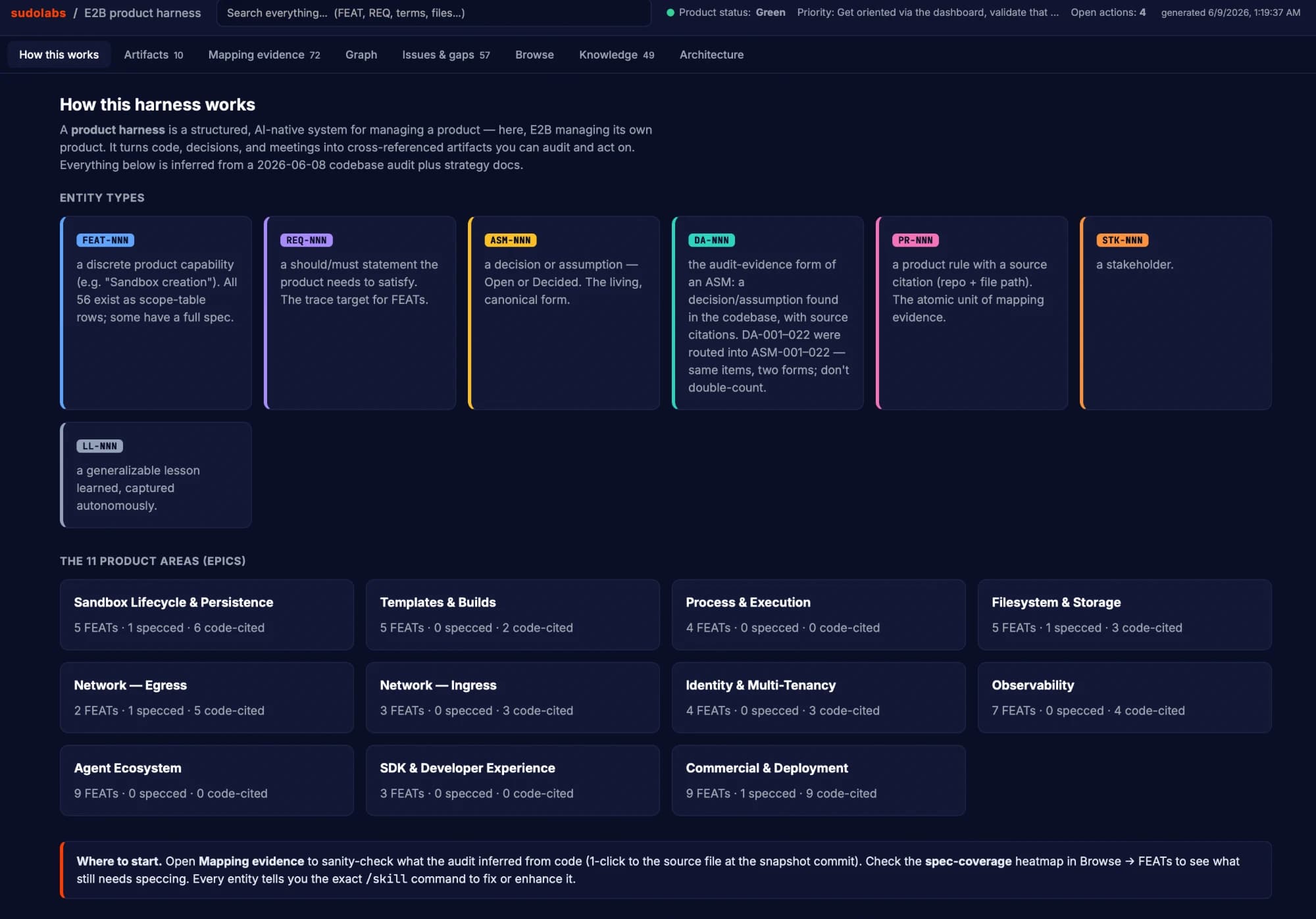
- Codebase-grounded baseline. The harness audited E2B’s infra, SDK and docs repositories. From them it produced the product brief, requirements, architecture reference, 11 epics and 56 mapped features, and 44 tracked assumptions and decisions. Every claim links back to the source file at the audited commit.
- 19 Claude skills for the PM workflow. Feature specs with adaptive Q&A and quality gates, scope and delivery tracking, a stakeholder map, daily logs and weekly status for team and leadership.
- Meetings and documents become structured knowledge. Transcripts and files are processed and routed to the right artifacts, and the PM confirms every change.
- E2B-specific guardrails. A deployment-parity check forces every feature spec to state how it works on Cloud, BYOC and self-host. Features are grouped by product pillar.
- A visual dashboard to browse the product, spec coverage and open questions without opening a single file.
Delivered as a proper product project in 8 weeks
A PM and an AI engineer (2 FTE) ran the engagement end to end, from discovery to onboarding and iteration:
- Discovery. Collected and analysed E2B’s needs with the product team; audited the codebase and mapped products, pricing and open questions.
- Architecture. Defined the harness architecture: artifact graph, routing rules, skills and quality gates.
- Build & test. Built on the Sudolabs harness framework and tested it against delivery experience from other client projects.
- Pilot. Shipped v1 to E2B’s product team for hands-on testing.
- Onboarding & training. Walked the team through daily use, from first meeting upload to first feature spec.
- Iterate. Collected feedback and improved the harness: spec granularity for agent-ready tickets, the review loop with engineering, and new feedback and market inputs.
From zero to 150+ feature specs in two weeks
The harness went into daily use across E2B’s product team. In the first two weeks it produced 150+ feature specs, about 10 per working day, each grounded in the real codebase and checked against all deployment models.
The bigger impact was the operating model. After the Head of Product presented the harness to leadership, E2B decided to scale the approach to more company domains:
- Engineering built an architect harness on the same pattern within days. It holds hundreds of generated architecture diagrams and reviews feature specs for feasibility before build.
- Marketing launched a copywriter harness that pulls from the product harness, so messaging now comes from the real product and not generic category language.
- Product is extending the harness with customer-feedback and competitor-market inputs, so every spec starts from what users and the market say.
“The product harness understands our product better than I do.”
Tech stack