
GForce
Predictive AMS platform that catches client churn before it happens
- 3,000+
- Brands managed
- 50+
- Agencies on platform
Sudolabs expertise
- Predictive AI
- Agentic AI
- Sentiment Analysis
- Multi-Channel Data Integration
- SaaS Product Development
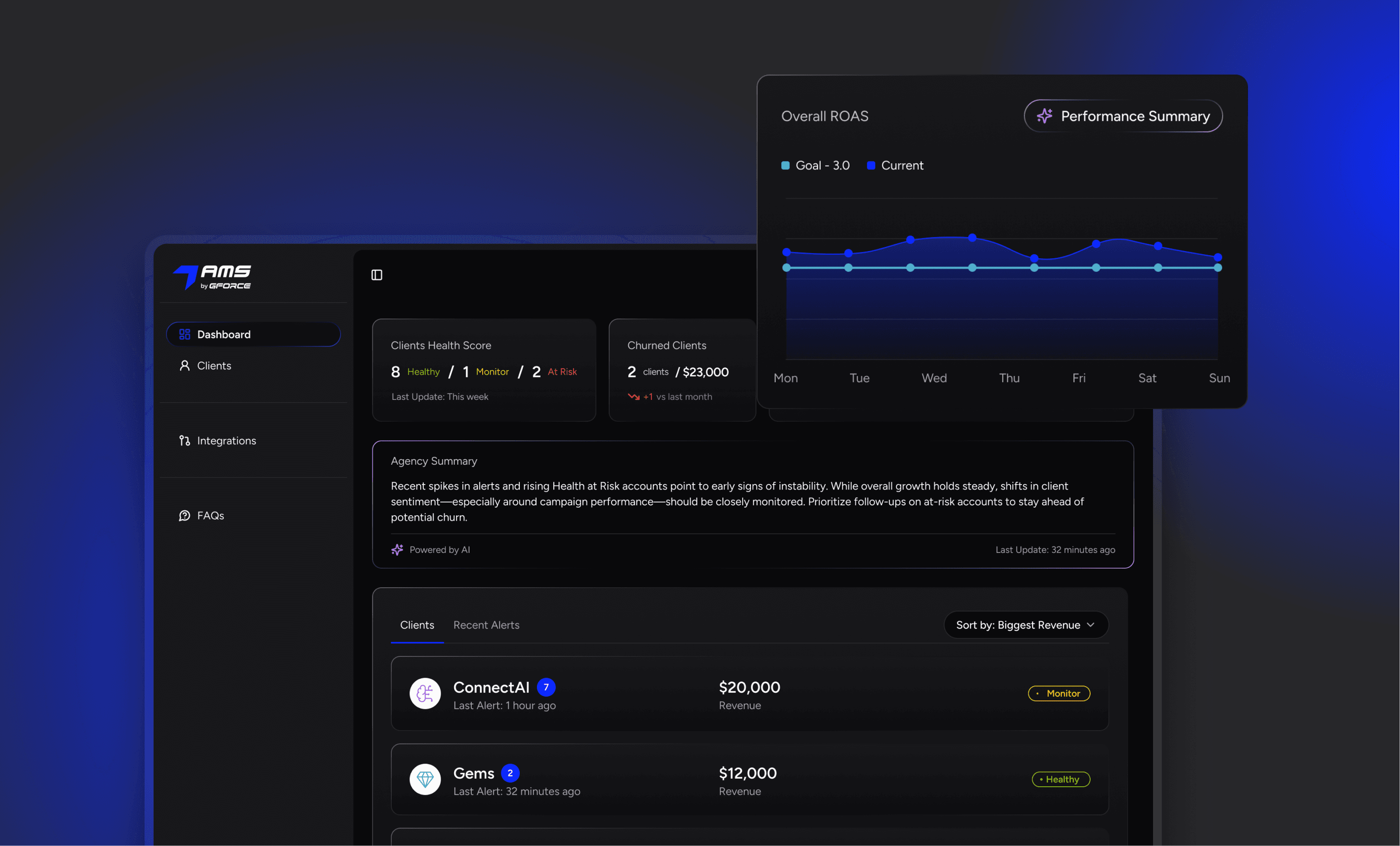
Performance marketing, managed at scale.
GForce is a U.S. consulting firm focused on performance marketing agency management — helping agencies build sales teams, retain clients, and increase lifetime value. Their flagship product, AMS (Agency Management System), is the operating system for the performance marketing ecosystem they serve.
Today, AMS powers oversight across 3,000+ brands and 50+ agencies. It is the single pane of glass GForce uses to keep enterprise-grade agency portfolios healthy, predictable, and growing.
But the platform that runs that scale didn’t exist until Sudolabs built it.
Churn signals everywhere. Visibility nowhere.
Performance marketing agencies live and die on client retention. But the early warning signs of churn — a cooling Slack thread, a frustrated email, a slipping campaign metric — sit scattered across half a dozen tools that nobody is correlating in real time. By the time a quarterly business review surfaces the problem, the client is already shopping for a replacement.
GForce needed a unified system that could ingest communication signals (Slack, email, call transcripts) alongside live performance data (Meta, Google, Amazon, TikTok, Klaviyo) and turn the noise into a single answer: which clients are at risk, why, and what’s the revenue exposure.
Off-the-shelf agency tools didn’t come close. The product had to be built from scratch — and it had to operate at the scale of an entire agency ecosystem from day one.
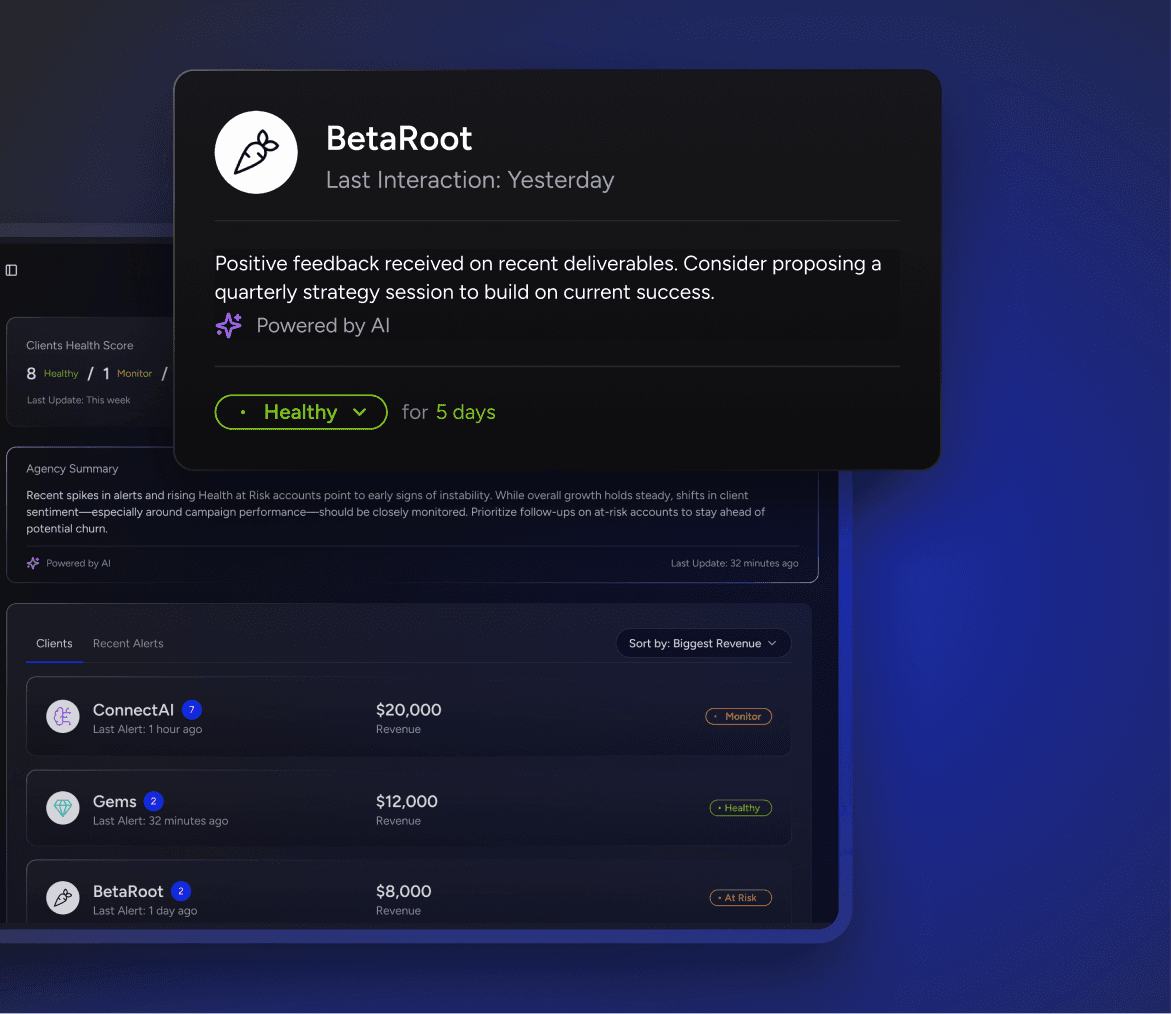
Sentiment + performance, fused into one health score.
We built AMS — a multi-channel intelligence platform that monitors client communication and marketing performance in parallel. The system pulls Slack messages, emails, and call transcripts on the communication side, and live campaign data from Meta, Google, Amazon, TikTok, and Klaviyo on the performance side. Ten distinct data types flow through the AI pipeline daily.
Predictive models analyse message sentiment alongside real marketing performance to evaluate overall client health, surface revenue-at-risk per agency, and generate prioritised churn alerts. Agentic summarisation distils what’s actually going wrong (or right) into plain-language insights that account managers can act on without parsing a dashboard.
Built on Next.js with Clerk authentication, the platform was engineered for SaaS-grade reliability and multi-tenant scale from the first commit — supporting the full GForce agency network without compromise.
- Multi-channel ingestion: Slack, email, call transcripts
- Live marketing performance integration: Meta, Google, Amazon, TikTok, Klaviyo
- Sentiment analysis fused with performance metrics into unified client health scores
- Agentic summarisation of key problems, opportunities, and revenue at risk
- Multi-tenant SaaS architecture supporting 50+ agencies
3,000+ brands. 50+ agencies. One platform.
AMS now serves as the central nervous system for 3,000+ brands across 50+ performance marketing agencies — a scale most agency tools never approach. Every day, the platform processes ten distinct data types through its AI pipeline, generating churn alerts that surface revenue risk before it becomes revenue loss.
The product turned GForce from a consulting firm into a platform business. Instead of advising agencies one engagement at a time, GForce now operates the system that runs their entire client portfolio — a fundamentally different commercial model with fundamentally different economics.
For the agencies on the platform, the impact is operational: account managers walk into client meetings already knowing which relationships need intervention. For GForce, the impact is strategic: a defensible product moat in a market that has been waiting for one.
Tech stack